Tag Archives: sewing

18th Century at the OT-Tea Party

Back in September I attended a fancy tea event called the OT-Tea Party. (It is a reference to OTT, meaning “over the top”). It was held in the gorgeous French Parlour at the Palace Hotel in San Francisco. Recently I received the official photographs from the event. (Pictures below are by KV Photography, with editing by Nicole Keane).

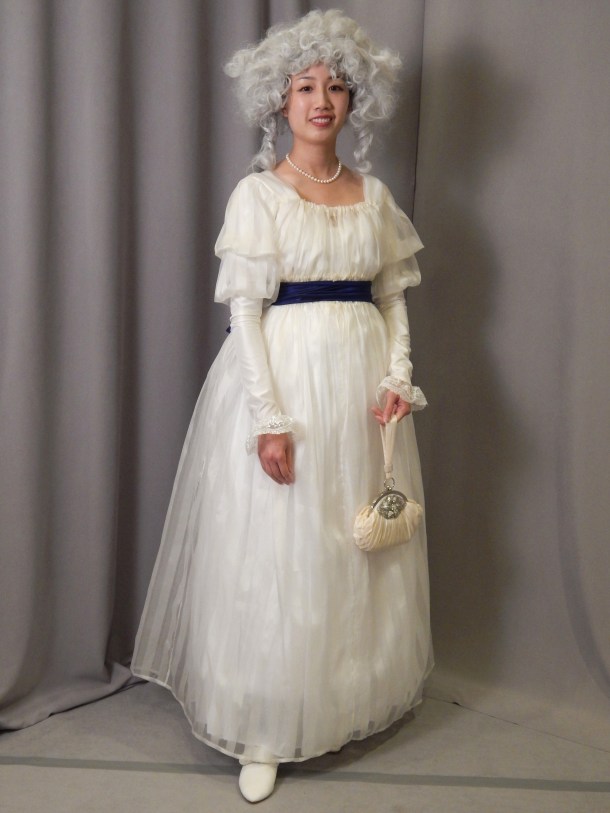
I wore a silk dress inspired by both 18th century gowns and Japanese lolita fashion. The dress is one of my favorite things I’ve ever made, and I’ve worn it to Costume College, Gaskells and PEERS balls, each time with a little change in the trimming or accessories.

24007948342_1c17f09645_o

I am wearing a pearl necklace and earrings, and a straw bergere I trimmed. My shoes are by American Duchess (the very first run of Georgianas!)23748249499_6142597493_o

I wish my hair had behaved a little better that day, but I had a wonderful time, and ate lots of delightful sandwiches and desserts.24089779936_50bef4e720_o

Here is the whole group together. There were so many amazing outfits and I hope the tea becomes an annual tradition!23488213444_df2dc8fd16_o


2015 Year in Review

I don’t usually do an end-of-year review, but I finished more than I thought this year, so here we go! (My plans for 2016 are at the end of this post).

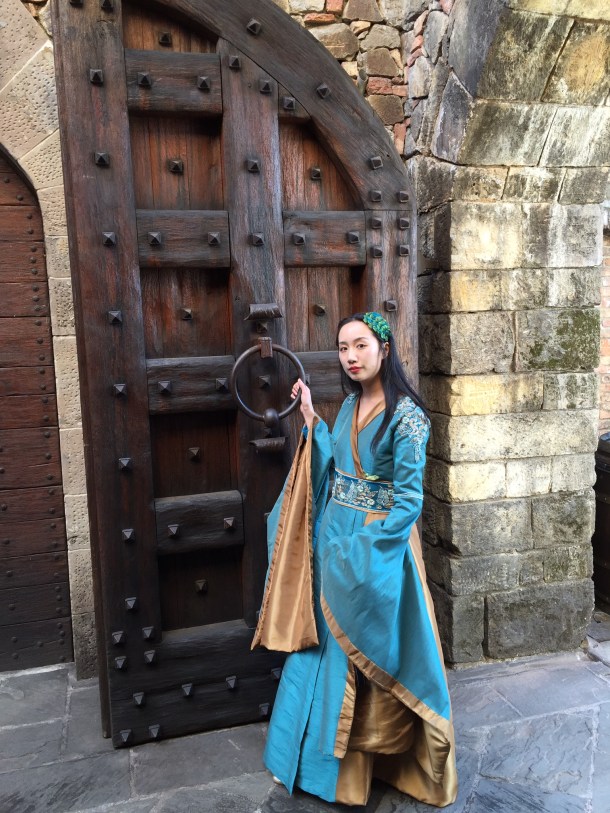
I made a Game of Thrones Kings Landing gown for myself, and an Oberyn
Martell-inspired costume for my husband.

IMG_1707

DSCN1478

I made two chemise a la reines (one cotton and one made of sheer
striped silk) and wore them together to a few events.DSCN1814

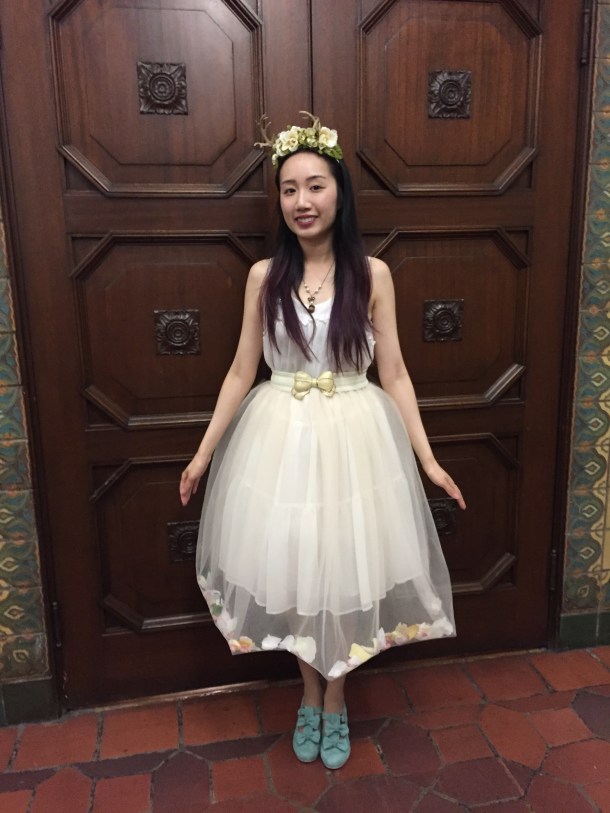
I had fun frolicking in a tulle fairy tale skirt.IMG_4895

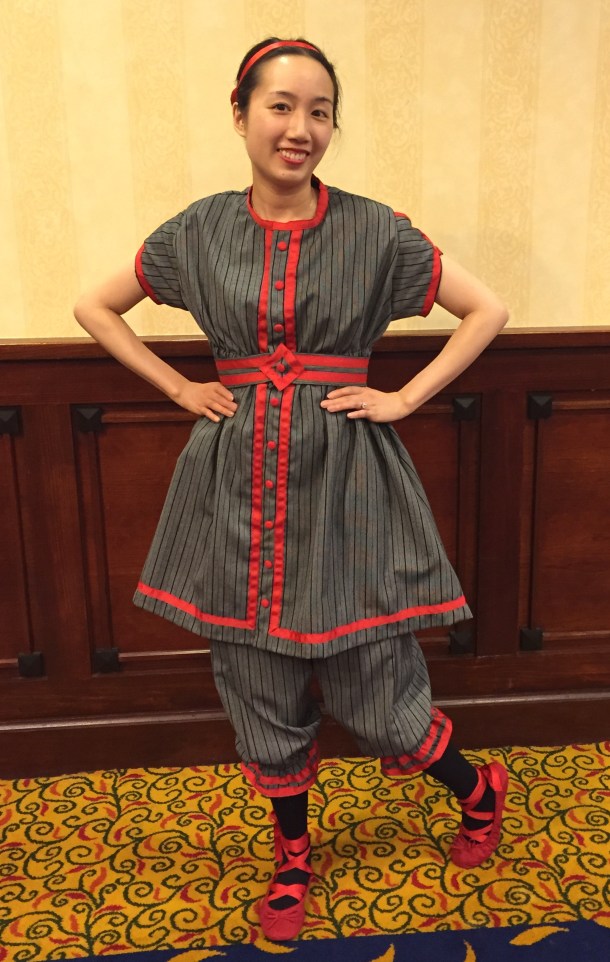
I made a wool-blend Victorian bathing suit.
IMG_5038

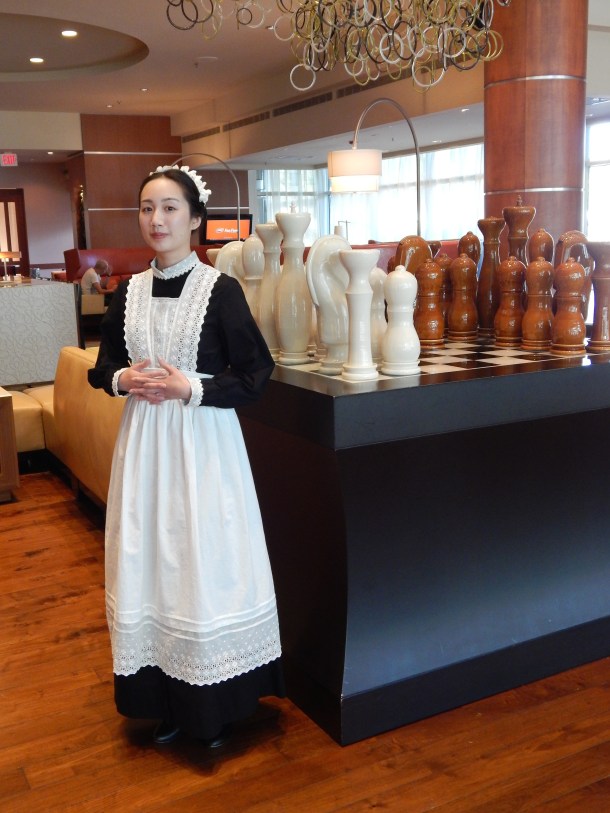
I was a maid from Downton Abbey.
DSCN1616

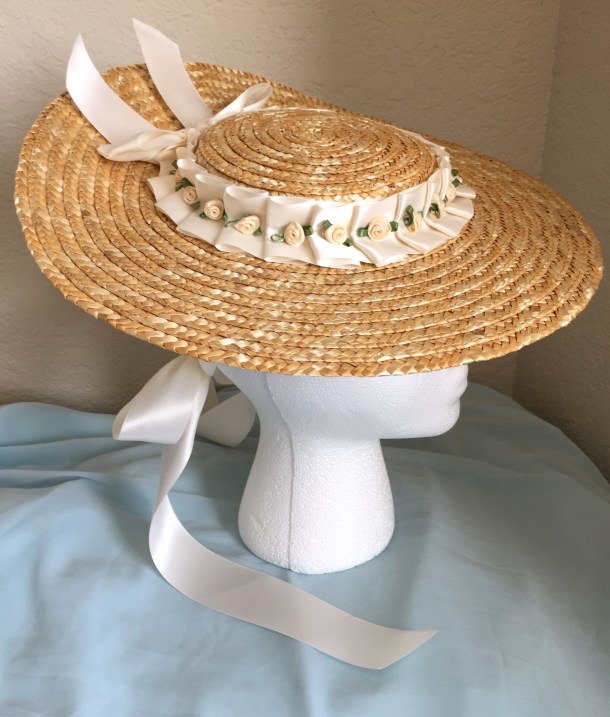
I retrimmed a bergere hat.
IMG_5412

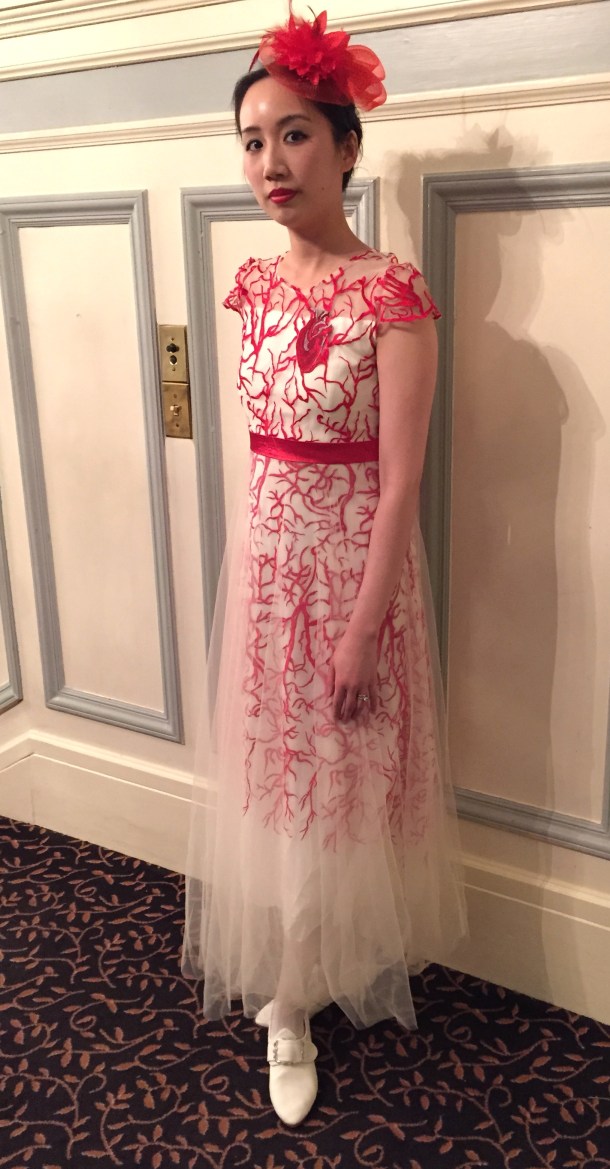
I attached appliques to a dress to make my Circulatory System outfit
for the Vampire Ball.
IMG_6037

I finished the underskirt and overskirt for my Lady Tremaine costume.
IMG_6133

I made new undersleeves for my 1850s silk plaid Victorian day dress.
IMG_6102

My final project of the year was my 1840s fan-front Victorian day dress.
IMG_6401

Goals for 2016:

  • Finally complete my 18th century stays! I actually “finished” them months ago except for the binding on the eyelets, but took a break from most hand-sewing because of a wrist injury.
  • Make the bodice for my Lady Tremaine costume.
  • Trim a hat for Lady Tremaine.
  • Sew a 1920s Egyptian Revival dress for a GBACG event.
  • New regency gown – not sure day or evening yet.
  • Make more PJs.

Wish list with time frame unknown:

  • Black silk 18th century market hat
  • Black chemise a la reine
  • 1940s cocktail dress
  • Fur muff
  • Velvet cloak

1840s Fan Front Dress at Dickens Fair

I have been so busy sewing a new 1840s Victorian dress the last several weeks that I didn’t even make any progress posts, so this will be a long one with lots of pictures and information about the pattern, accessories, hair, and such. I started sewing after my last visit to the Dickens Fair at the beginning of the season wearing my 1850s plaid silk dress, so this dress only took a few weeks!

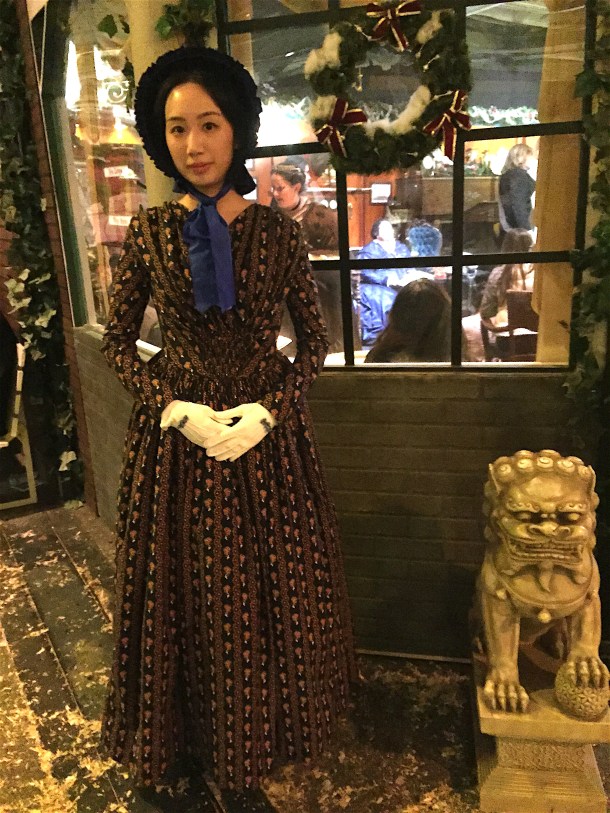
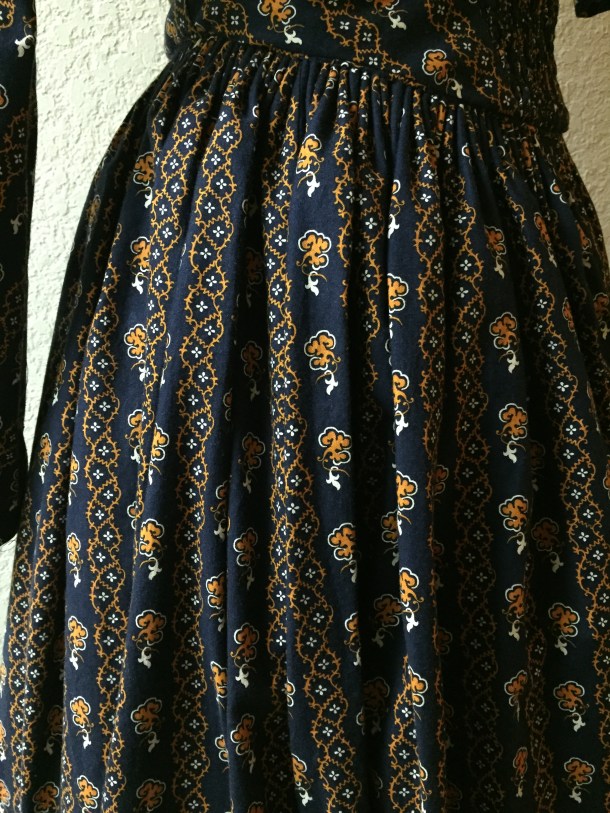
I made an 1840s fan front day dress out of a wonderful reproduction cotton print by Andover Fabrics, based on an antique quilt housed at the University of Nebraska. It’s a very nice machine-washable fabric that doesn’t seem to wrinkle much. I was able to take this out of the dryer and not iron it before sewing!

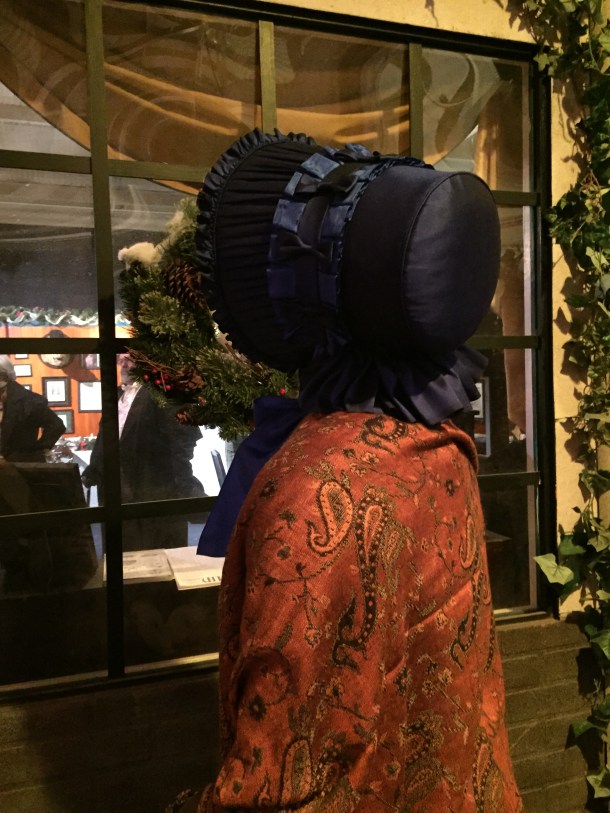
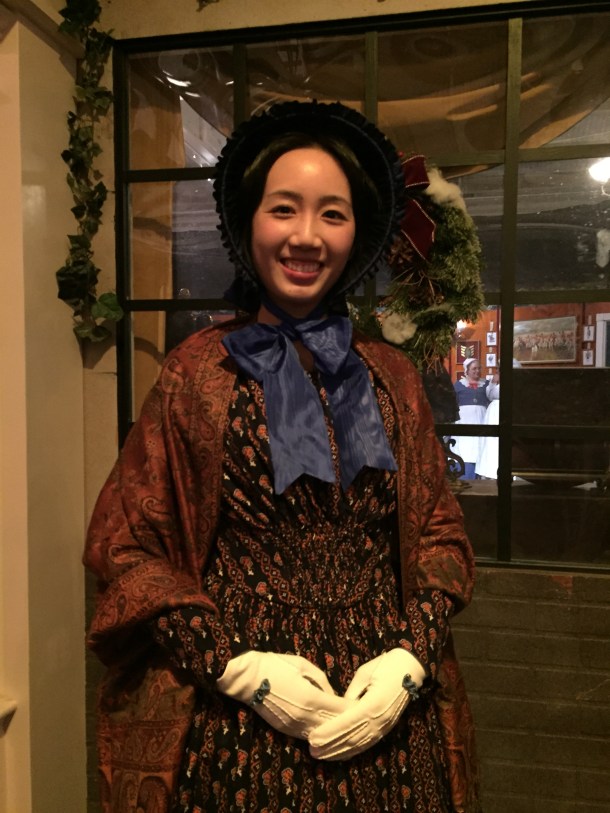
I wore my dress with a cashmere/silk paisley shawl and a gorgeous sapphire silk taffeta bonnet made by my friend Lynne Taylor (more on that later).

IMG_6389

I apologize for the quality of the pictures; the lighting at the Fair is terrible. I do have detail shots taken at home following these photos.IMG_6401IMG_6406IMG_6410
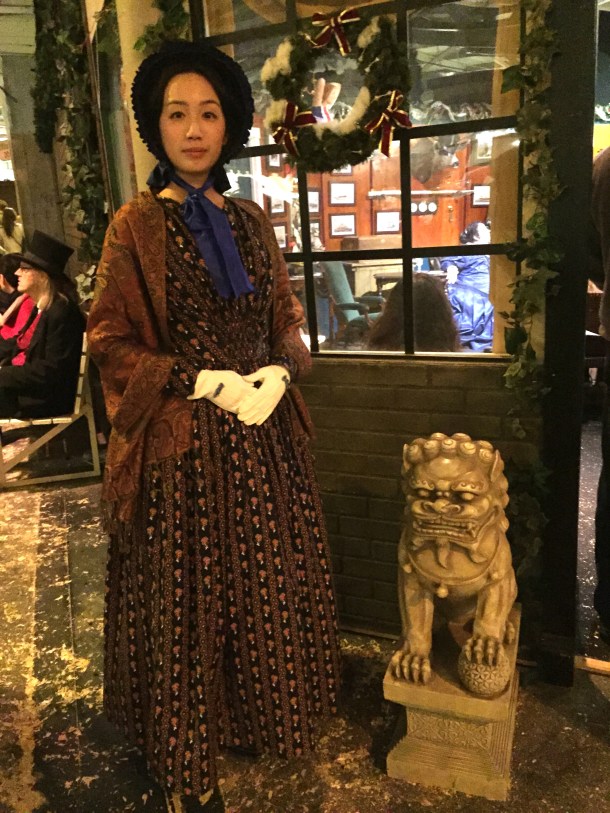
I wish I had darker gloves; I think the white gloves look rather stark against the navy and orange.IMG_6368

I put piping in the neckline and bottom of the bodice, but it gets lost in the dark and busy print, so I didn’t bother piping the shoulders and sleeves.IMG_6371

The front is gathered into the shoulders.IMG_6373
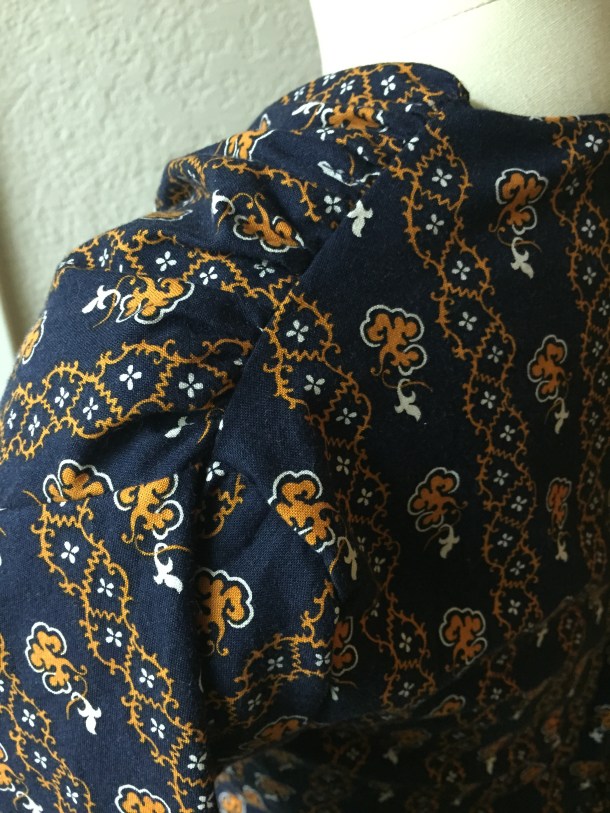
The back closes with 8 black hooks and bars. My husband was complaining they were hard to see when he helped me get dressed.IMG_6375

The side panel is cut on the bias, so I couldn’t quite get the pattern to match up.IMG_6380

I am pleased with how invisible the hem came out.IMG_6377
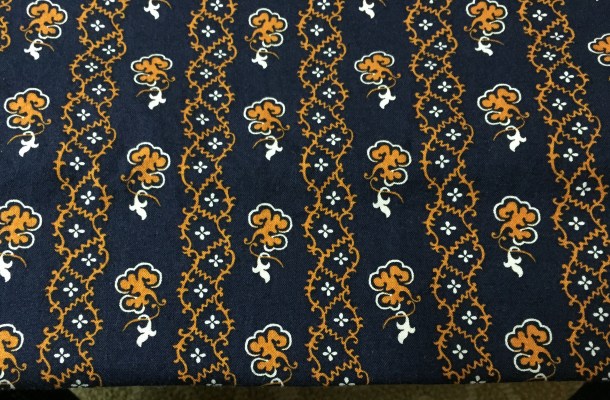
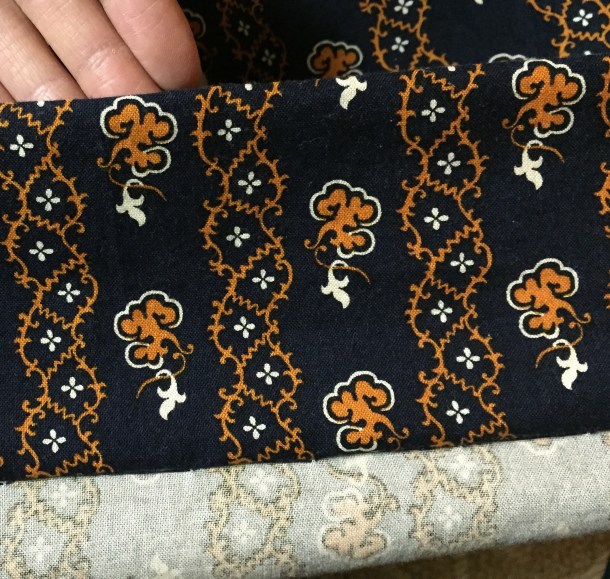
I ended up with more leftover fabric than I anticipated according to the pattern. I didn’t know this when cutting out the panels, so my hem facing is only a few inches deep this time.IMG_6379
Can you see the pocket hidden in the side seams? The pattern has huge deep pockets and I put one on each side. It was actually a little awkward trying the reach the bottom of the pockets, but I was able to hold my wallet, phone, keys, fan, water bottle, tissues, a snack, a tin of hair pins, a schedule, and my ticket!IMG_6383
I used the Laughing Moon Round Dress #114 Pattern. It is a decent pattern, but I recommend some changes if you use it:

  1. The shoulders are very broad. I had to take mine in at least 2 inches and adjust the armscye. Two friends of mine also used this pattern and had to do the same.
  2. There is a lot of fabric in the front bodice overlay, and I think you can get a more flattering shape if you increase the gathering. The pattern calls for 7 rows of gathering in the center bottom front, but I tripled that. I added extra rows in between the original rows, and additional rows above it so that the fan rises higher.
  3. I saw a few reviews that said the sleeve is a bit wide, and one friend said it is a bit short too. If you like a more tightly fitted sleeve you’ll need to adjust the pattern. (I ended up reusing the sleeve pattern from my chemise dress, with some minor changes, but I still cut the sleeves on the bias).
  4. If you have a 45 inch fabric the pattern recommends cutting 3 panels of that, plus a 13 inch wide panel, and making a final hem circumference of 144 inches. Regardless of the skirt style I like to have 3 panels so I can have pockets in the side seams and one seam in the back for the opening, so I skipped the 13 inch panel. My skirt was narrower, but I wanted a smaller silhouette to navigate the crowded fair with.
  5. The pattern calls for boning in the darts of the lining. I gathered my fan so tightly that the front panel was already pretty stiff, and I made this dress to be machine washable, so I skipped that step.

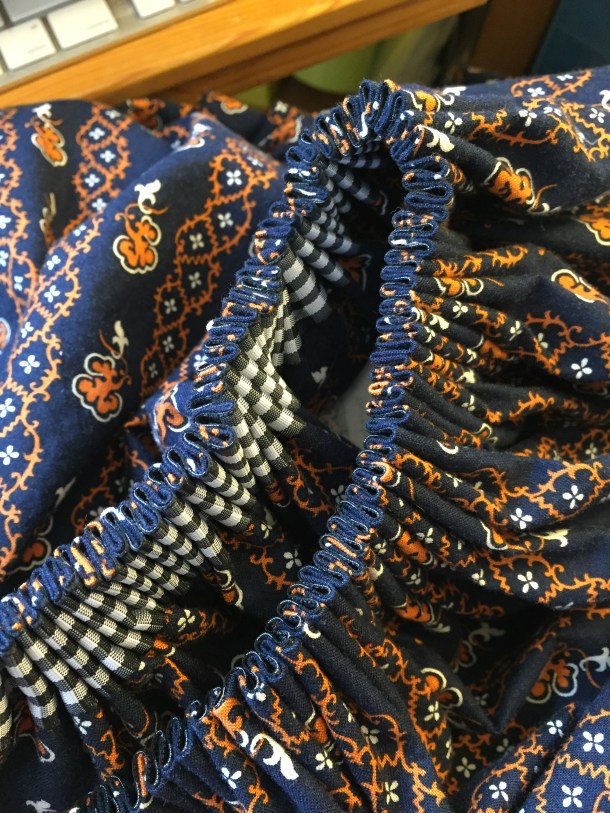
The skirt is cartridge pleated, and I used gingham ribbon as a stitching guide, rather than tediously marking 2 rows of dots a half inch apart. Fold over the top of your skirt like you normally would when cartridge pleating, then lay the ribbon over the fold. Use the little squares as a guide for your rows of stitching, and the ribbon will be sewn to the skirt. When you are done, the ribbon remains, and also adds extra body to your pleats!IMG_6305
As I mentioned earlier, my coal scuttle bonnet was made by Lynne Taylor. She is a very talented milliner and did a lovely job. The bonnet is wired buckram, covered in sapphire blue taffeta. (It is much brighter than it appears in the pictures). The inside and outside are pleated, and the top of the crown is double piped and padded. There are little bows over the moire ribbon that circles the middle of the crown, and the same moire is used for the ties. IMG_6390IMG_6392

I was delighted with the whole ensemble, and will gladly wear it again to fair next year (and to Costume College as well!)

For my hair I tried to fake the 1840s style. I took a large section of hair on each side of my head and coated it with lots of mousse, then curved it gently forward and then up, and then pinned it to the side of my head. I then did my usual little bun on the back of my head, covered with a big fake braided bun. Since most of my hair is covered by the bonnet all you see are the “droopy puppy ears” and not the messy mass of bobby pins on my head and doesn’t matter if the rest is not appropriate to the decade.IMG_6387
Final cost of the dress, minus accessories:

  • 7.25 yards cotton fabric: $50 + $12.65 shipping (from destash group on Facebook)
  • Bodice lining left over from other project: $0
  • 1 roll gingham ribbon: $2.99 plus tax (from Michael’s)
  • 1 hank nylon parachute cord for piping: $1.79 plus tax (from Michael’s)
  • 1 package skirt hooks and eyes: $3.74 (from Amazon)
  • Pattern: $18 (from Amazon)

Edit (I forgot to add in the pattern!) TOTAL: $89.34

The dress was worn over 4 petticoats (1 ruffled, 1 corded, and 2 flat) that I already owned for other outfits.

I still have 1 yard of the printed fabric left. Normally I would want an evening bodice when I have leftover fabric, but the cotton is not right for that, and the skirt is gauged onto the bodice, so I will have to figure out what to do with it!

Pink Plaid Silk Dress at the Dickens Fair

Last Saturday I went to the Dickens Christmas Fair and wore my 1850s silk plaid dress. Here I am on the streets of “London” (photo by Laurie Tavan):

12314105_10102716988924215_833594469844977127_n.jpg

I made the dress last season (and you can read construction details here), but I had a few new accessories this time. IMG_6184.JPG

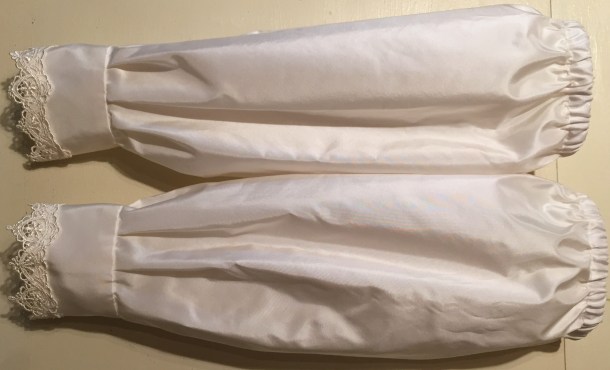
I made a new pair of silk taffeta undersleeves. They are so easy to make! Normally I machine sew as much as I can, but these are completely hand-sewn because I needed a small project for a sewing party. The overall steps were:

  1. Make a rectangle of fabric a little longer than your forearm and sew into a tube with French seams. (My tube was a little curved at each corner for a slight barrel shape).
  2. Make a cuff by sewing a tube of fabric, then folding it in half.
  3. Gather one end of fabric into the cuff and stitch. (Slip stitch on the inside to finish).
  4. Make a channel in the other end of the sleeves and place elastic into it to gather.
  5. Sew lace onto the cuffs.

I have small hands so I cheat on sleeves by making closed cuffs instead of buttoned cuffs. The elastic end goes around your upper arm above the elbow and should be tight enough for the sleeve to not fall down, but not so tight it is uncomfortable.

IMG_6102.JPG

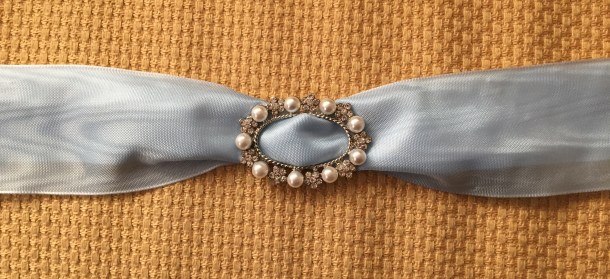
I made a simple belt using some moire ribbon, backed with satin ribbon, and a pearly slider buckle.

IMG_6212.JPG

I dressed up a pair of vintage gloves with some new ribbon roses.These gloves are not new, but I decided to wear cotton gloves instead of the kid leather gloves I wore last year, because Dickens Fair is rather dusty, and these gloves are much easier to clean!IMG_6217.JPG

Lady Tremaine (Part 4)

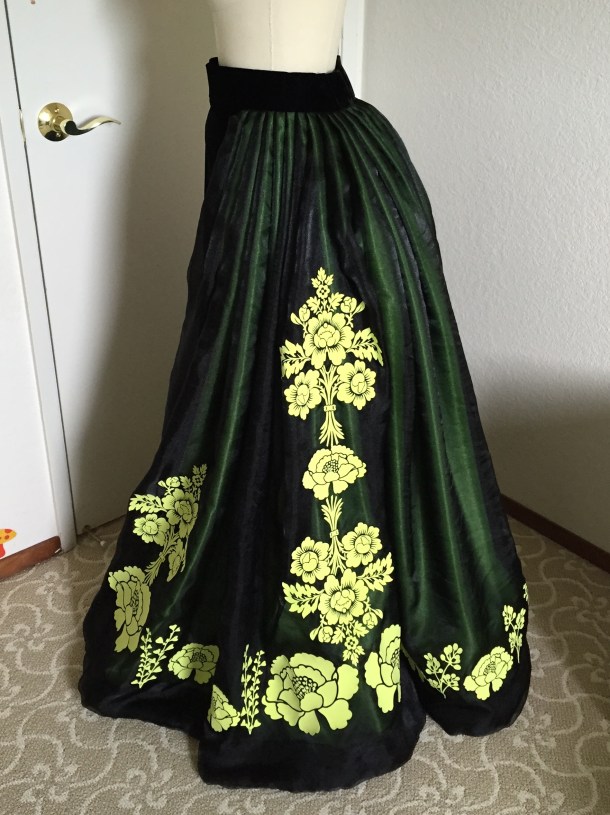
At long last the skirt for my Lady Tremaine outfit is done! I’ll post a tutorial for the under and overskirts later, but for now here are some pictures of the two together.

First is a side view. I stuffed a pillow under the skirt for the photos, but later I will be making a small bustle pad specific for this outfit.

IMG_6133

Here is a view showing the open front with the black velvet underskirt.IMG_6139

And a view from the back.IMG_6125

I took some liberties with the flowers. I used a lot of poppies and leafy sprigs, while Lady Tremaine’s skirt has more abstract flowers and vines.IMG_6126IMG_6127

Since the skirt is open in the front, I put the closures on the side. The skirt is pleated into a velvet waistband made from the same fabric as the underskirt, and closes above the hip with some heavy duty hooks and eyes.IMG_6144

If you’ve been following the story, getting the material for the appliques was quite the saga!

  1. Supplier #1 sent me a bright neon green flocking material, when I wanted chartreuse. I couldn’t find chartreuse flocking anywhere, so I switched to wool-blend felt.
  2. Supplier #2 had to send me felt swatches twice, after the first set got lost in the mail.
  3. After I received the swatches, Supplier #2 said they didn’t have the full amount of chartreuse felt I wanted.
  4. I felt the felt (ha!) I did get in the end didn’t cut cleanly enough for the flowers to have neat edges, so I went back to flocking.
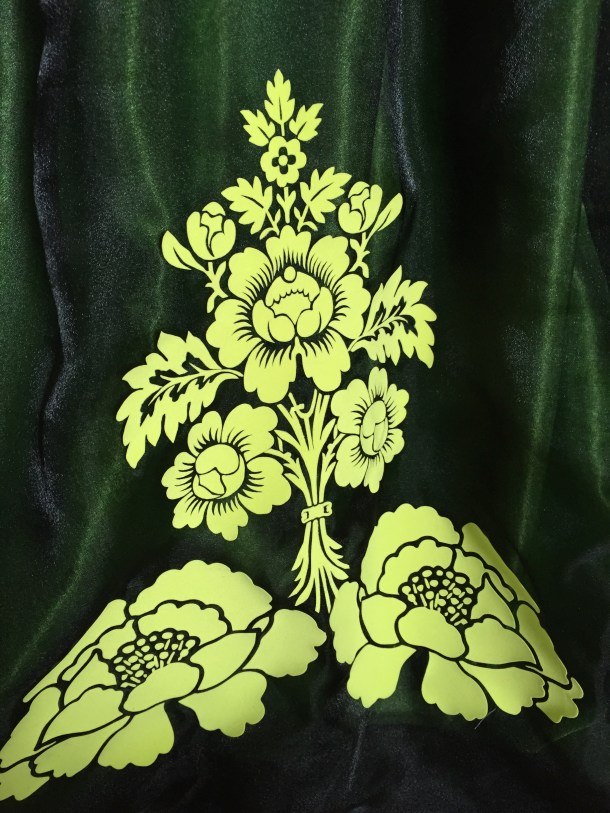
  5. I took a gamble on Supplier #3, where I bought a roll of flocking. Despite being labeled “green,” it was a little too yellow for me, but still better than the bright neon green I got at first.

I would have preferred a color in between the two below, but the bottom is still closer to what I wanted.

IMG_6117

I used a Silhouette machine to cut the outlines of the appliques, then used a little hook and spatula to weed out the excess material (which took a really, really long time). What is left behind is velvety flocking on one side (and attached to a plastic backing sheet), while the other side has a heat-sensitive adhesive that melts into the fabric.IMG_5977

This was probably the most terrifying project I’ve done! The iron had to be hot enough to fuse the flocking, but not so hot it would melt the organza. I had to make sure the adhesive didn’t bleed through the organza into something else underneath, so I had to protect the areas around and beneath the applique with plenty of parchment paper.

Heat-transfer flocking is best done with a large heat press, but I used an iron. I had a little bit of puckering in some areas, but I think the iron gave me more control, especially over the small detailed areas, even though it took longer!

For the bodice I will be using black heat transfer flocking, which is luckily much easier to find. However, I’ll have to experiment again with the temperature sweet spot that will fuse flocking to sequins without melting them.

Read parts 1, 2, and 3 here.

Lady Tremaine (Part 3)

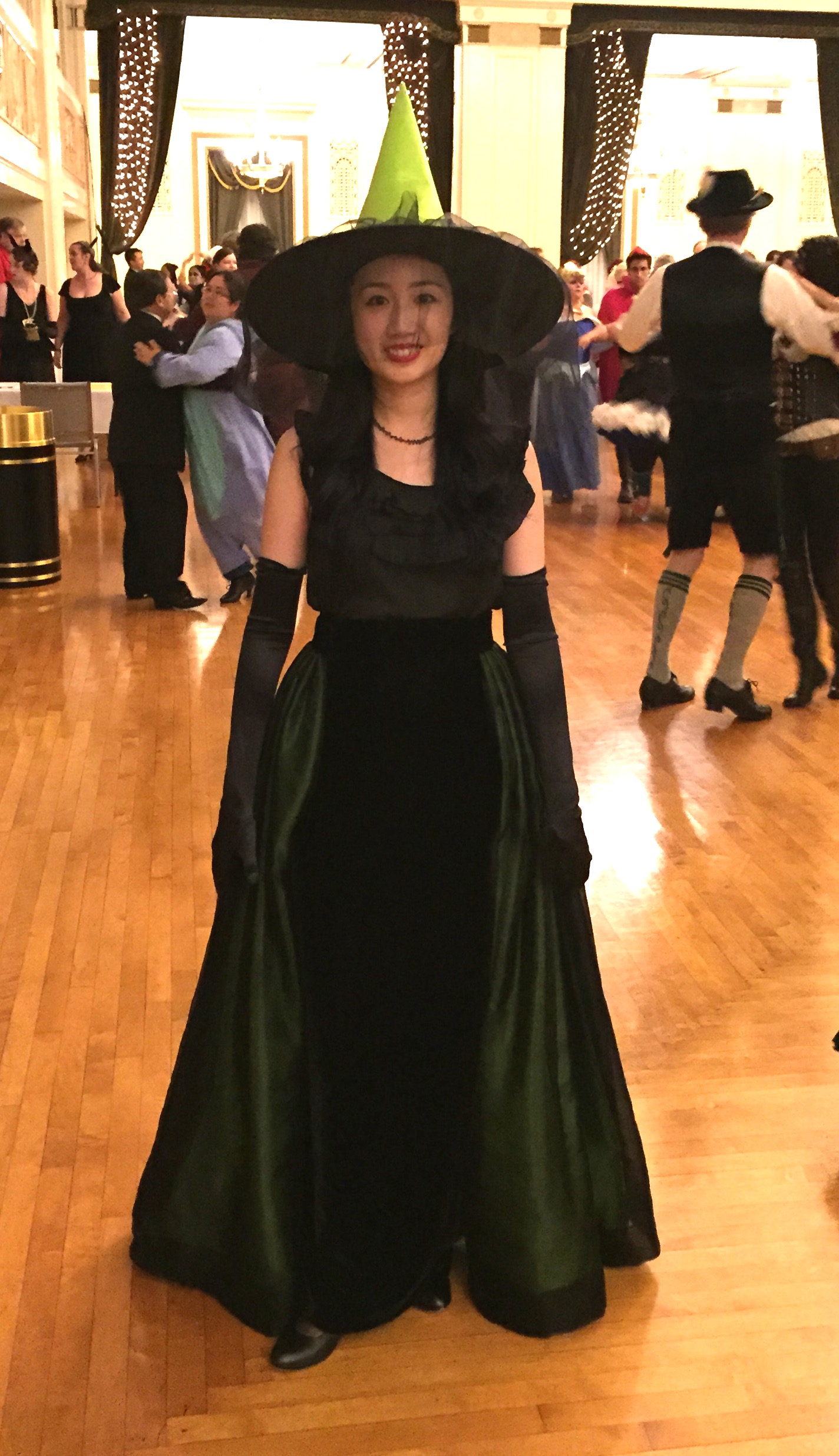
I am done with the base of the green and black overskirt, and am about ready to start making and attaching the floral appliques to my Lady Tremaine traveling outfit. Last night I wore the skirt (and the velvet underskirt from Part 2) with a matching green and black witch hat and veil to the Gaskell Halloween Ball.

IMG_5847 IMG_5848

The satin portion is 2 layers of satin fabric, flat-lined for extra drape. Sandwiched in between the layers is a 6-inch wide band of horsehair crinoline sewn into the hem to give it more body. The crinoline actually cost more per yard than the fabric (and it doesn’t even show!), but it gave the hem the slight pop that I wanted. The sheer portion is 2 layers of organza, with an extra wide seam allowance at the bottom to form a black decorative band. The black and green portions were sewn separately, and then serged together at the top and pleated as one. I don’t do anything fancy; I just “eyeball” it and decide it’s even enough. =)

IMG_5811

The waistband is velvet with heavy interfacing inside, to blend in with the velvet underskirt. The waistband closes with hooks and eyes on the side of the skirt near one hip.

I waffled back and forth between knife and cartridge pleats a few times. At first I intended to knife-pleat, since the movie skirt appears to have simple pleats. However, when I started that I realized my fabric was so bulky it was better to cartridge pleat. Then when considering cartridge-pleating 4 yards of 4 layers of fabric into a 14-inch area, I started thinking “Gee, I wish I used taffeta instead!” (Taffeta is so much thinner than the 2 layers of satin I’m using, but I decided to go with satin because I wanted a heavier drape and liquid-like flow, like the satin of Lady Tremaine’s ballgown, shown below).

Cinderella stepmother Ball gownPhoto from this blog.

In the end, I had to use knife-pleats, even though my waistband was a little bulky, because the skirt would have been much too short if I folded over the top edge to allow for cartridge-pleating.

For practical reasons my skirt is shorter than the movie version. I will be roaming around Costume College next year in this dress, and don’t want to trip because I am clumsy. Plus, trains get terribly dirty, and I can’t do a dust ruffle because it would show in the front. I am glad I made the choice to make a shorter skirt, because I was able to dance in this outfit. I loved the way the skirt swirled when I spun!

IMG_5878

Retrimming an 18th Century Bergere Hat

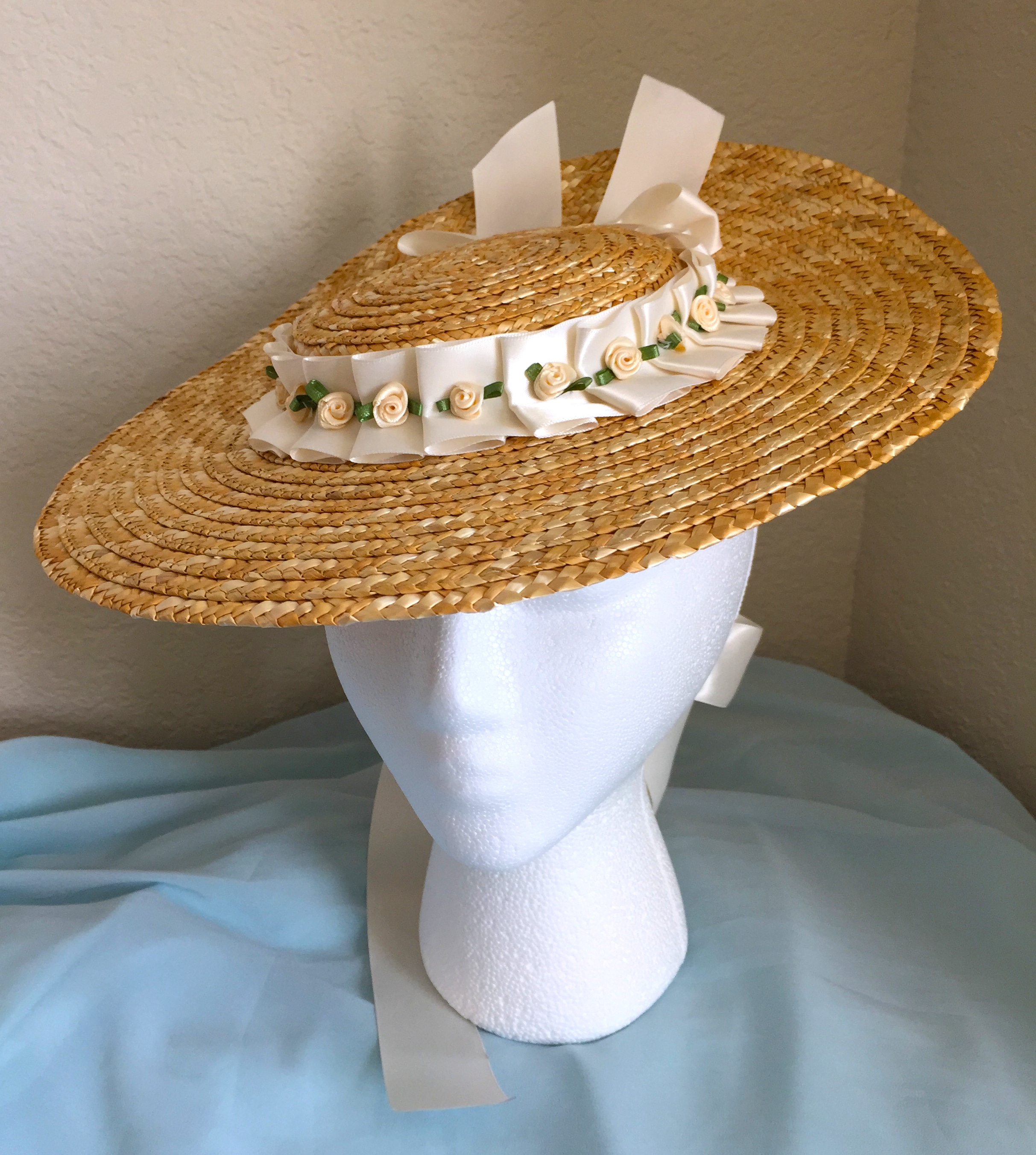
This weekend I am going to a fancy tea party, so I decided to retrim a small straw bergere hat I have. I was originally going to use silk ribbon and make little puffs, but realized I didn’t have enough to trim the hat and also have matching ribbon ties. Instead I used the leftover ribbons and ribbon roses from a dress I made. My other idea was the cover the hat completely in silk, but I decided to skip that for now.

IMG_5412IMG_5414 IMG_5405 IMG_5410

Previously, the hat was trimmed to match another outfit that consisted of a navy blue skirt and red and blue jacket. This is what the hat looked like before:

IMG_5373

I am considering trimming a pair of gloves to match, but that may be a little too over the top. =)

18th Century at the Pelican Inn

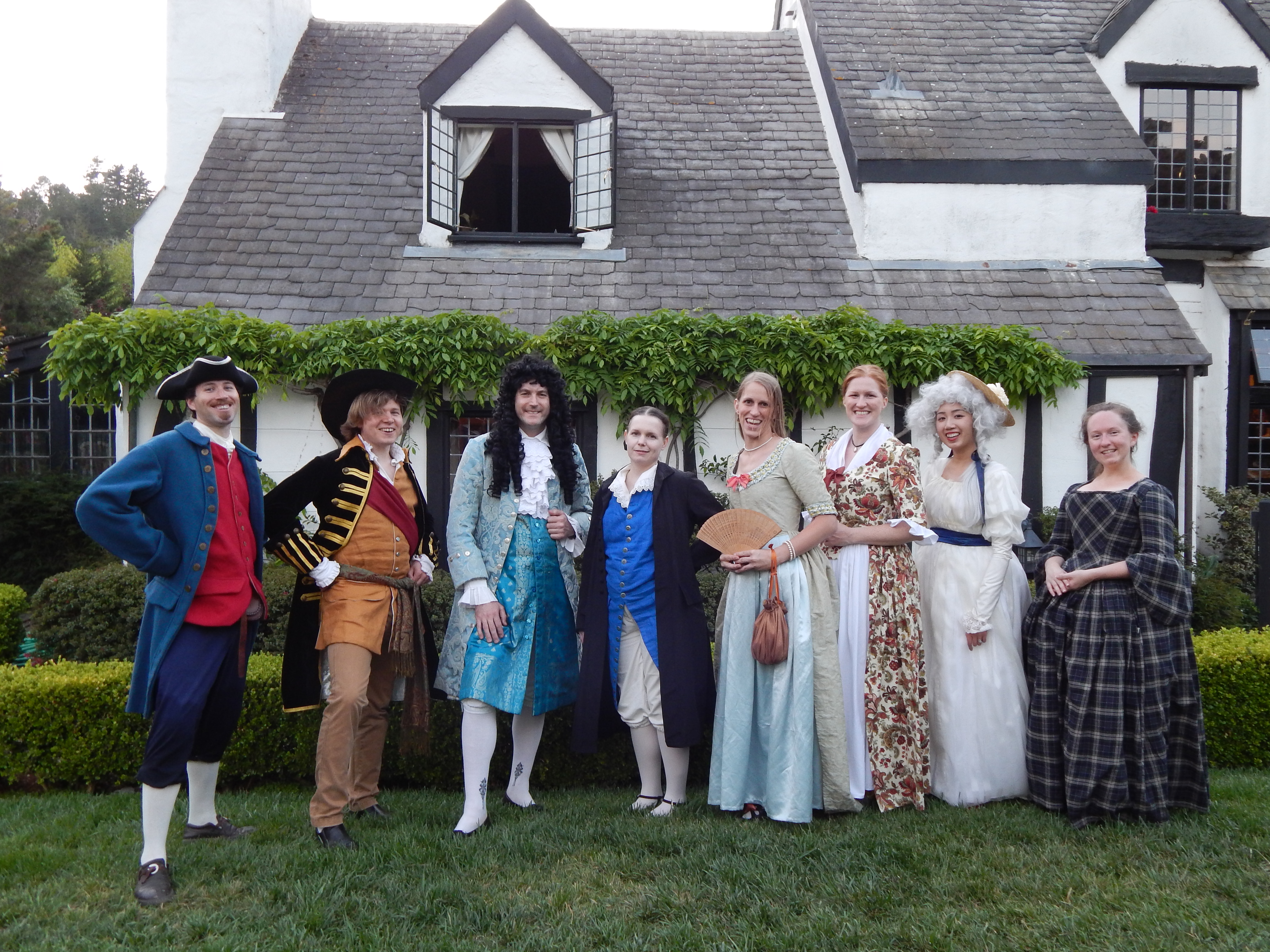
Last weekend a group of friends decided to gather at the Pelican Inn in Muir Beach to have dinner and take photos. The Inn is a very charming building, and we thought it would be nice to go there wearing 18th century outfits, and also visit the beach just down the road. I also finished my hedgehog wig, and so it was the perfect opportunity to take daylight pictures of my sheer striped silk organza chemise a la reine!

DSCN1524 DSCN1525I also wore my red hooded mantle when it got cooler in the evening on the beach. It matched perfectly with my red American Duchess Kensingtons!

DSCN1557I made the wig the day before, so it was a little rushed and not perfect, but I think a little more careful trimming will make it into something quite nice. I used the instructions in Kendra’s 18th Century Hair book, and I highly recommend it. There are wonderful step-by-step instructions and lots of color photographs. The overall steps were:

  1. Comb out a portion in the back that will remain straight.
  2. Put the rest of the hair in curlers.
  3. Boil the wig to set the curls.
  4. Tease the curls, except for 2 large side curls.
  5. Trim off the extra length.

We had a delightful time at the Inn, and it is a nice place for a small gathering.

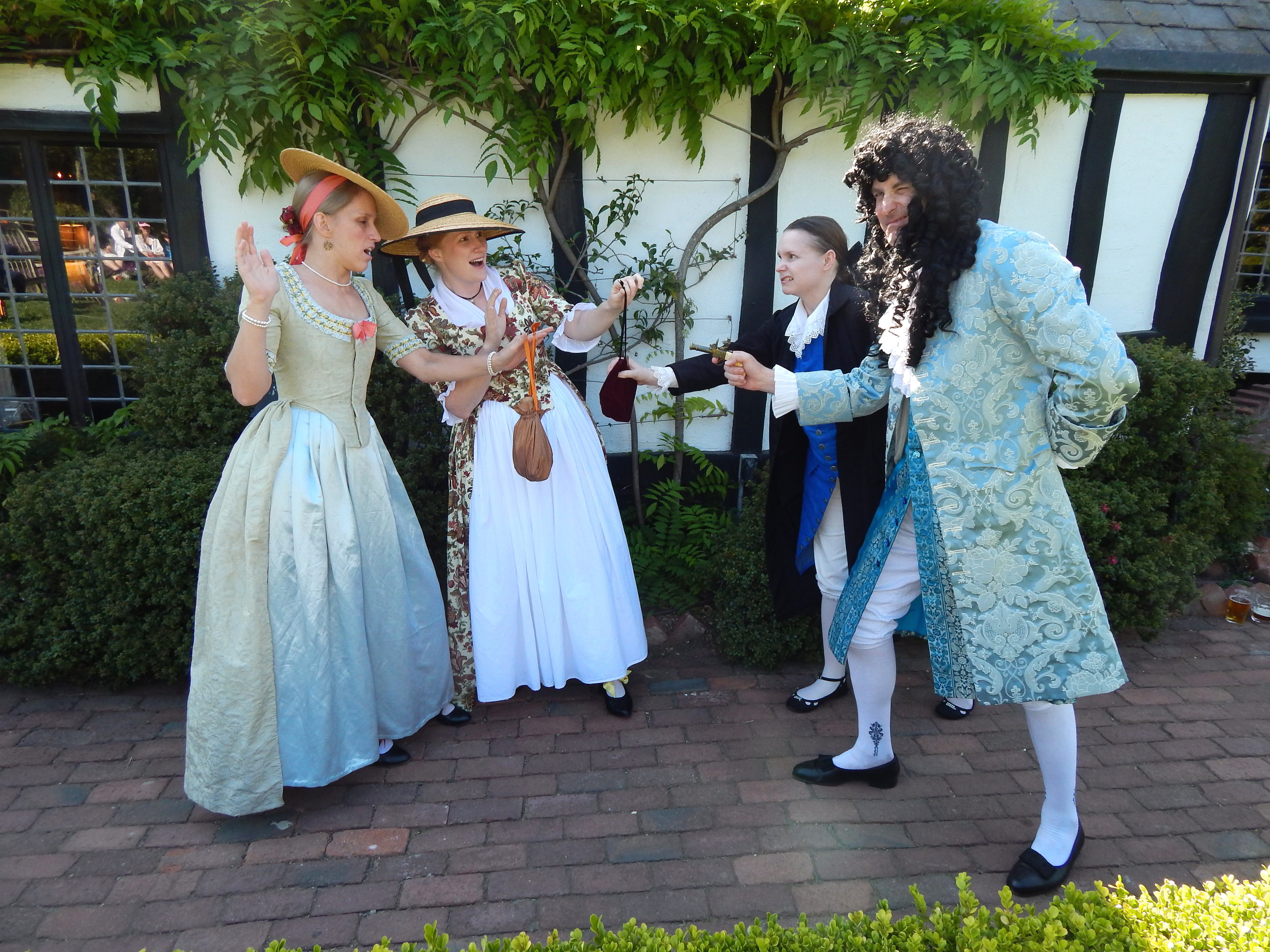
DSCN1598Although you must be on the lookout for highwaymen!

DSCN1532But fear not, you may be rescued!

DSCN1578Or maybe not.

DSCN1572For more fun photos see my Flickr album.

Downton Abbey Edwardian Maid Dress (Part 3) Finished!

My Downton Abbey Edwardian maid outfit is finished! It was actually completed last week, but I didn’t have time to take and post photos.

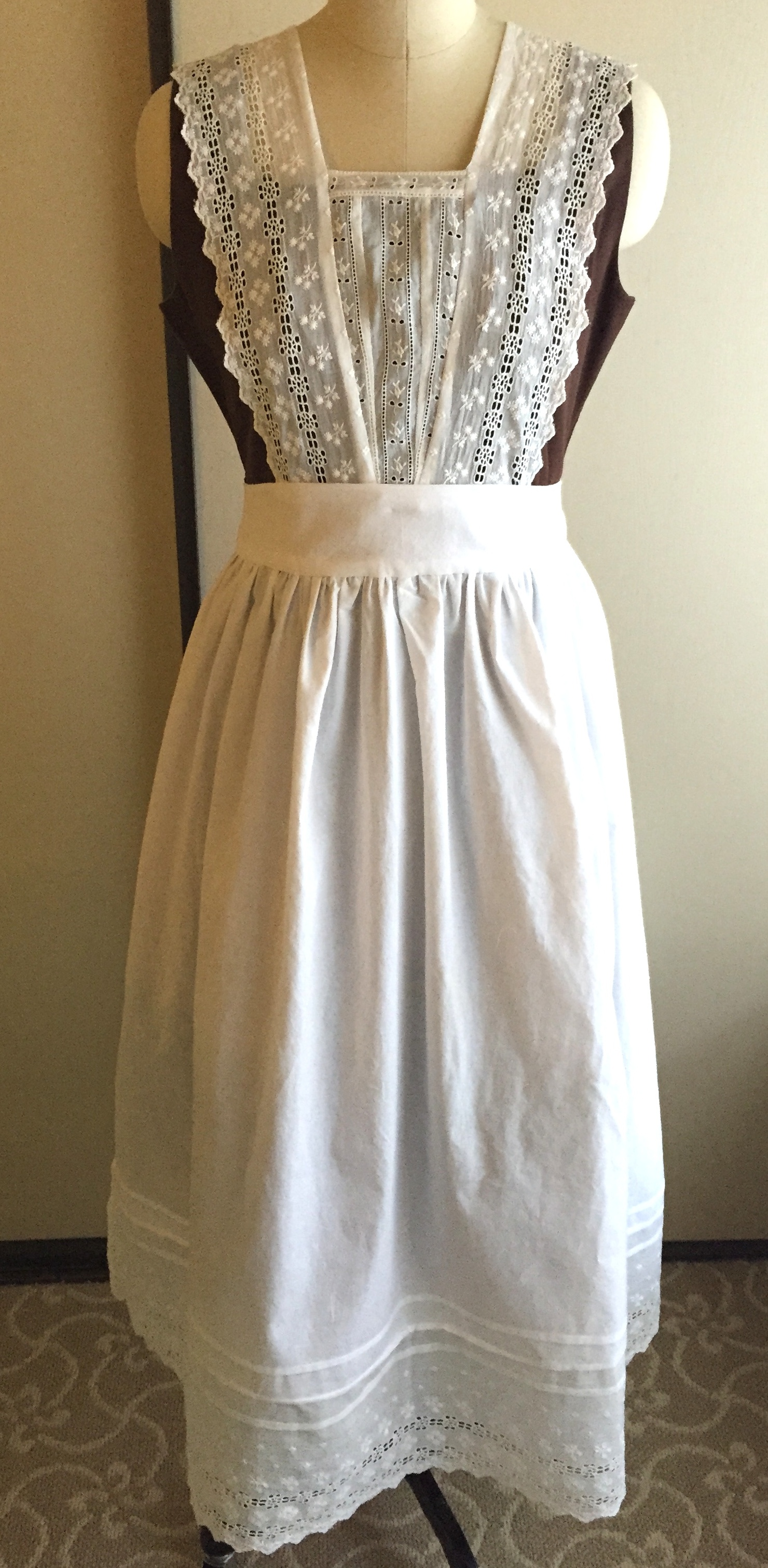
Here are the front, side, and back views with the apron on:

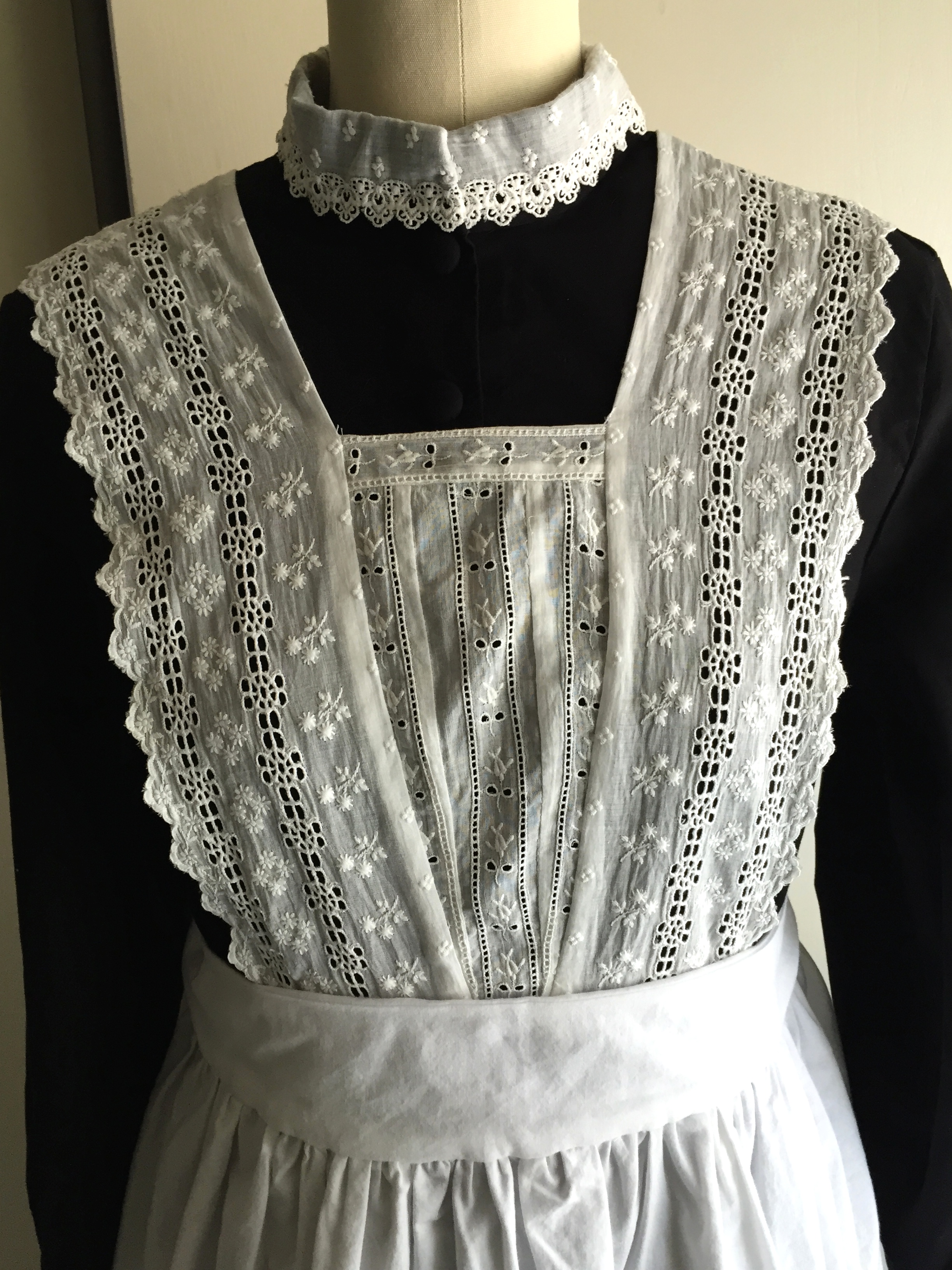
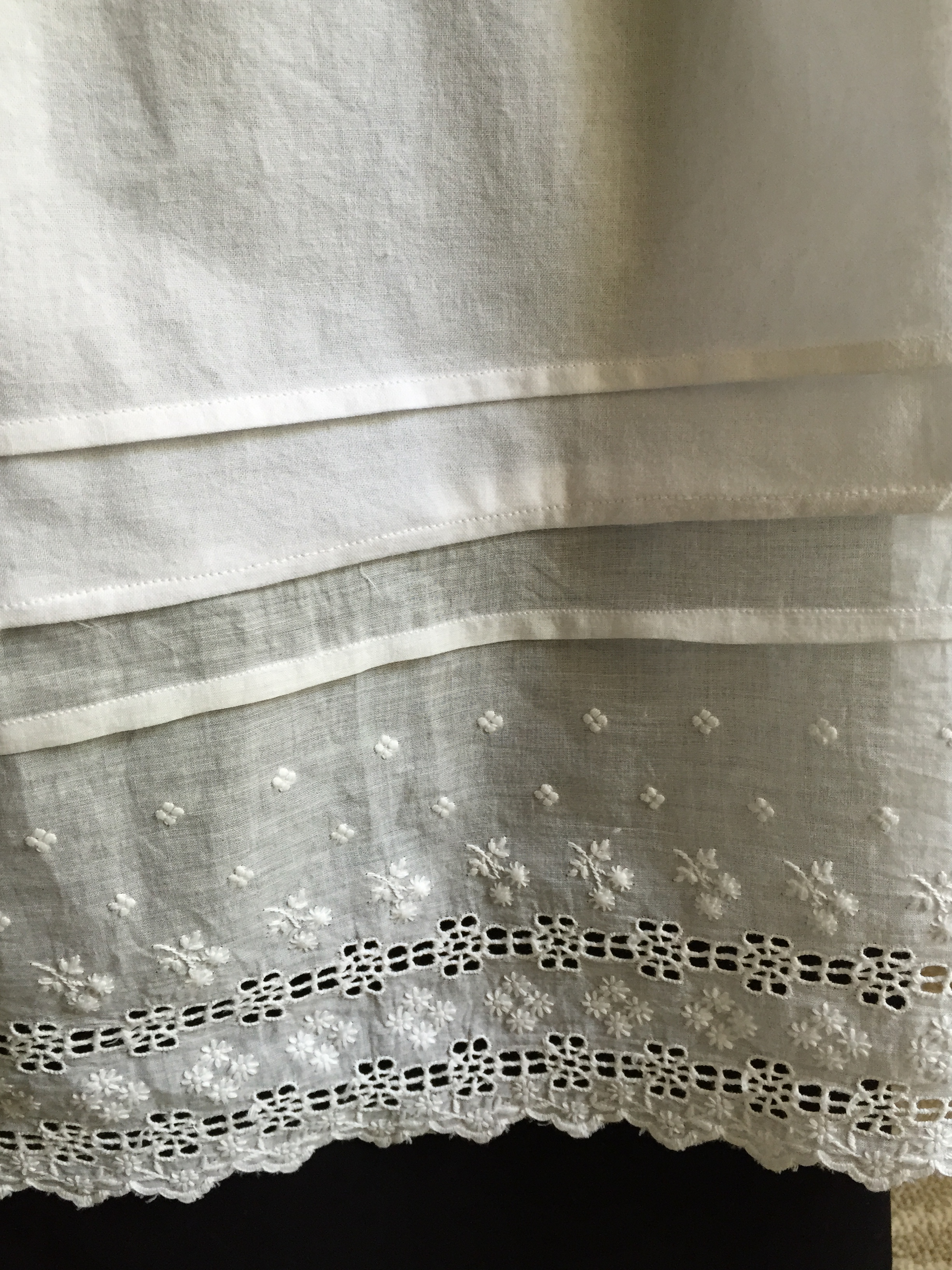
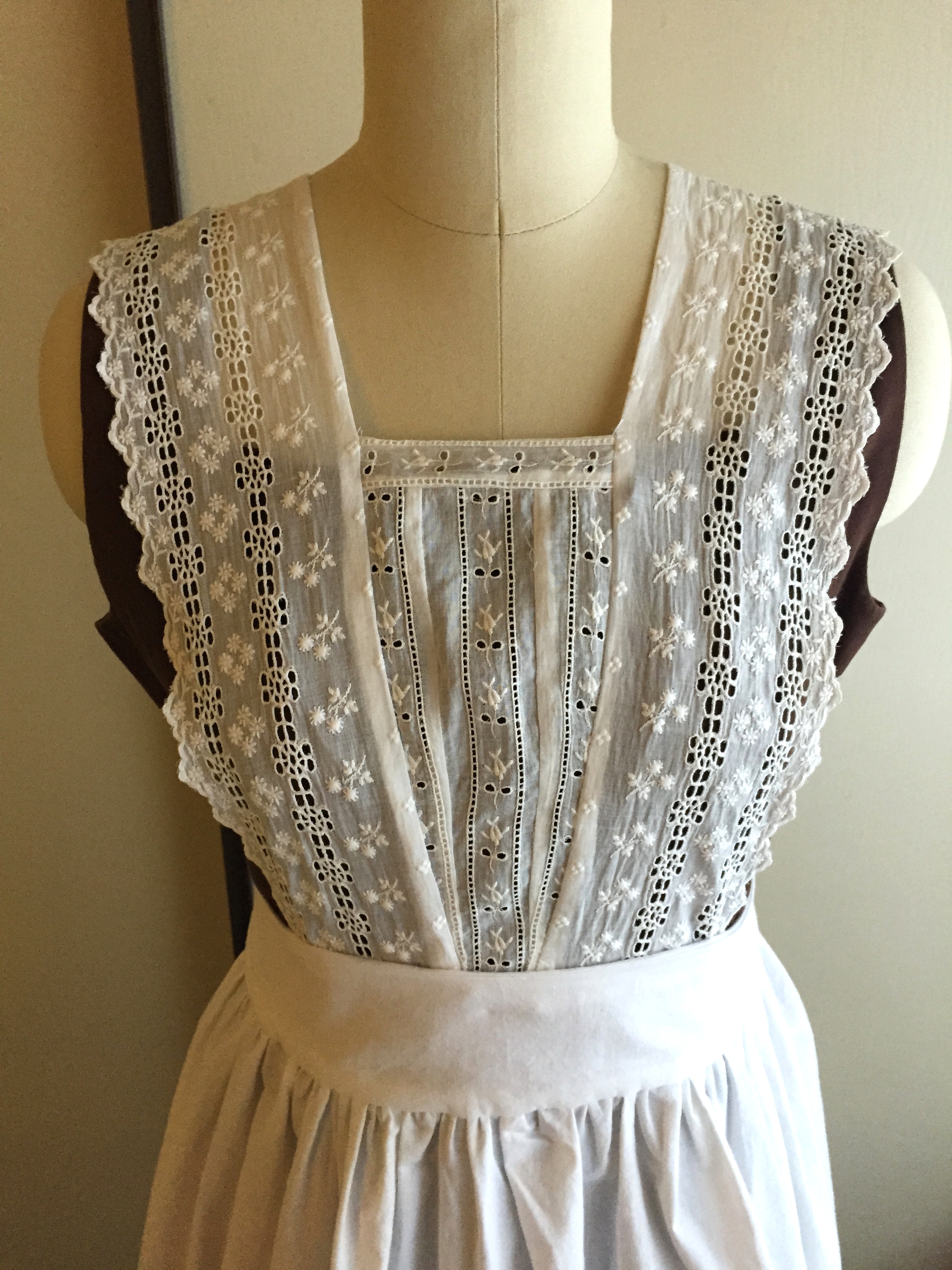
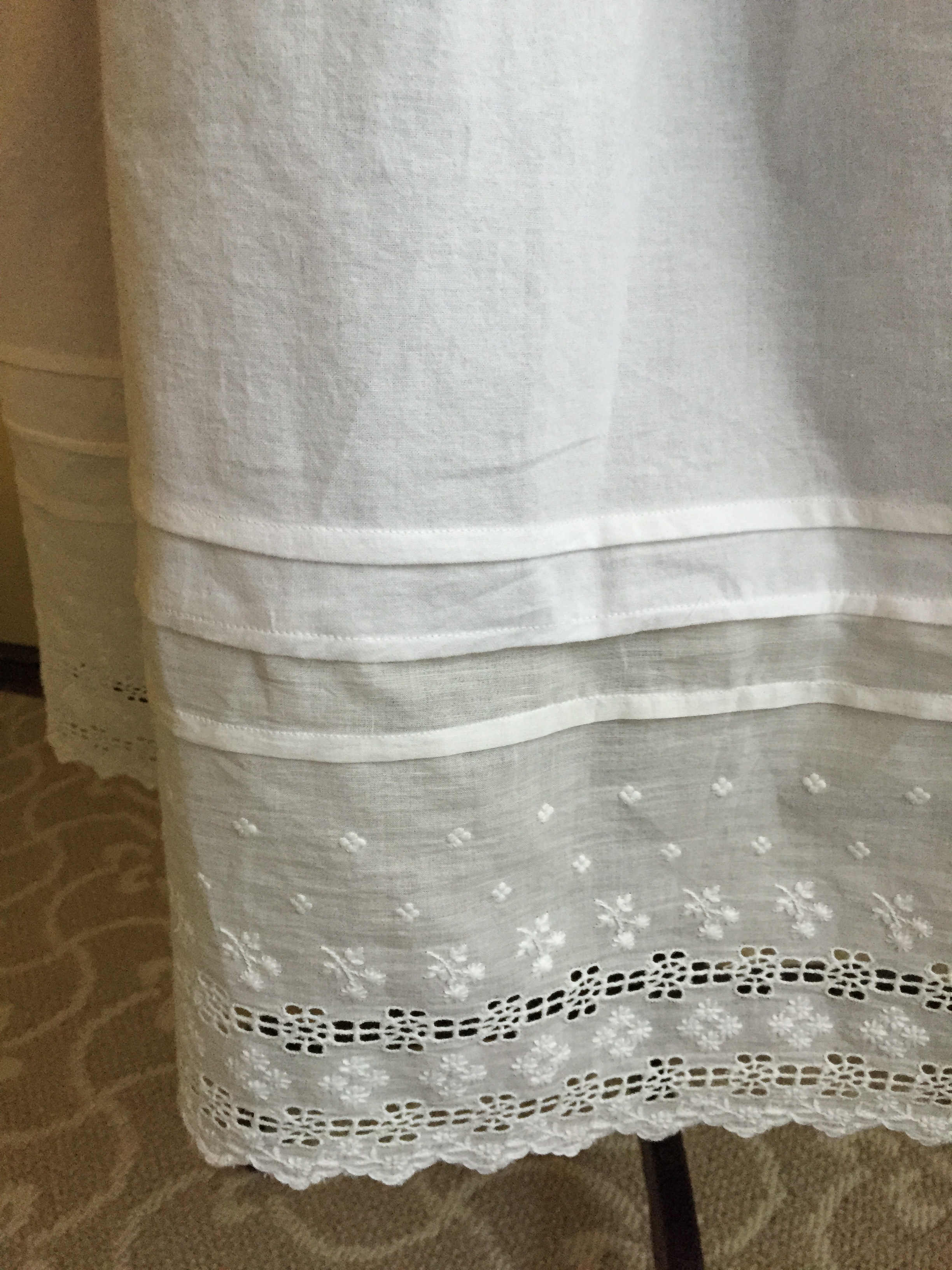
IMG_4826IMG_4828IMG_4830Here are close-ups of the top and bottom of the apron, featuring the same antique lace:
IMG_4836IMG_4839The lace on the collar and cuffs are the same, and also antique lace purchased in the same lot as the apron lace.

Here is the dress by itself. Although I originally thought of using wool, I ended up using black Kaufman Kona cotton, which I found to be decently thick, and a good value. I made the fabric-covered buttons using a button cover kit.

IMG_4816I used Butterick B6229 pattern for the dress (but not the apron), which I recommend. I found the pattern to be true to size, and the pieces fit together nicely. I used the pattern mostly as-is, with a few small changes:

  1. I made the cuffs smaller. I found them to be disproportionately large compared to my small hands.
  2. I shortened the height of the collar. If I followed the pattern the collar would be rather tall, and cover most of my neck. Although you can find old photos of Edwardian maids with similarly high collars, I wanted the shorter collars featured on the show.
  3. I lengthened the belt an inch or two; I found it a little short.
I normally don’t pay full price for a Big 3 pattern, but it was so new it was not in my local Joann’s or being sold for cheap on eBay, so I had to order it online. However, given how easy it was to work with I think it was worth it!

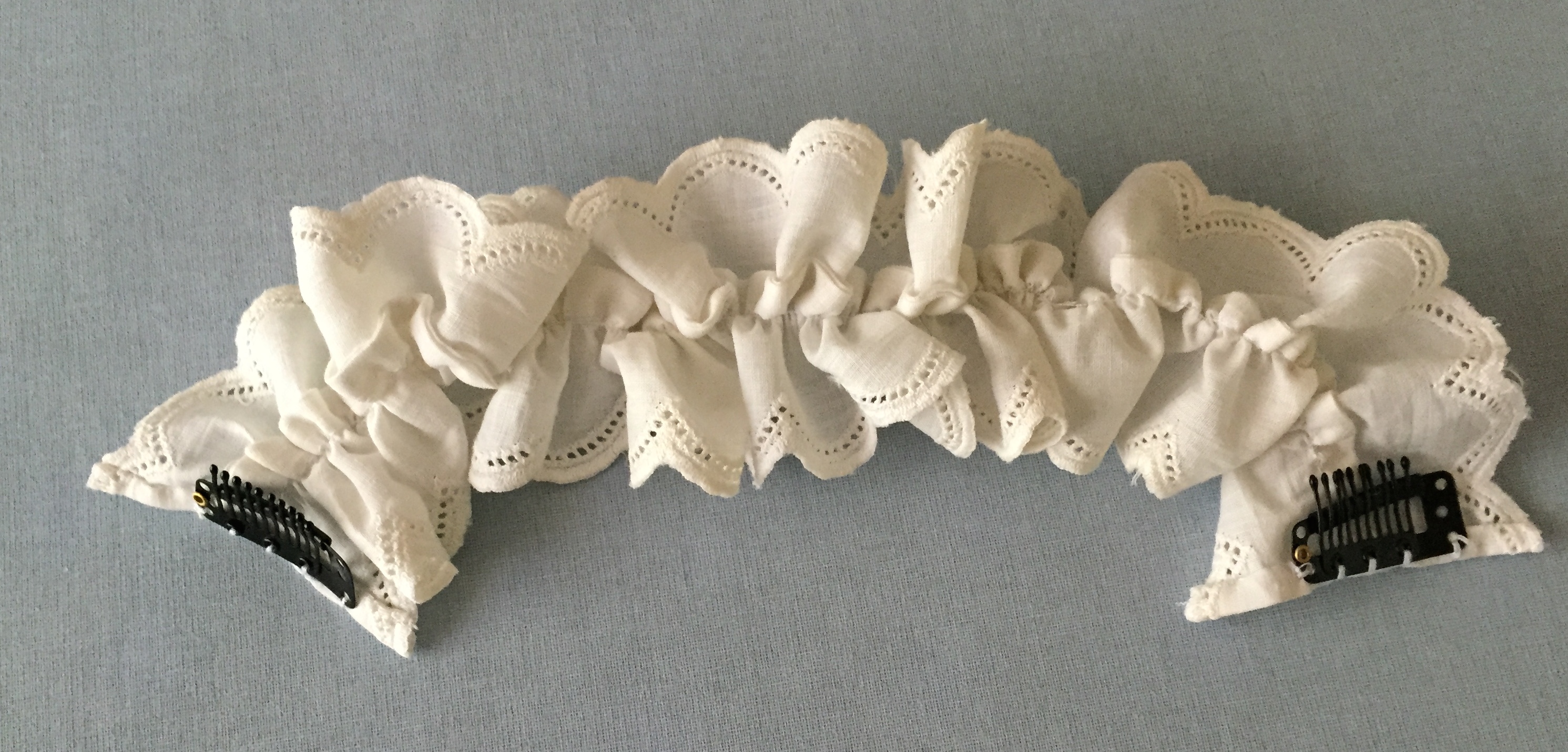
For the headpiece I sewed two pieces of antique lace together and gathered the center.

IMG_4832

I sewed wig clips to the back to hold them in my hair.IMG_4835  Project total costs:

  • Antique lace: $16.95 + $2.50 shipping (from Etsy)
  • Butterick pattern: $12.50 + $5.58 shipping and tax (from butterick.com)
  • 5 yards black Kaufman Kona cotton: $24.82 including tax (It’s normally $5.98/yard from Fabric.com but I had a coupon, free shipping bundled with other items, and a bonus half yard for free)
  • 3 yards white cotton broadcloth: $8.24 including tax (normally $2.98/yard at Fabric.com)
  • Button cover kit: $5.75 + $2.25 shipping (from Etsy; I still have buttons left over)

Total cost: $78.59. (I still have 2 yards white cotton, and a lot of lace and buttons left over for another project).

See parts 1 and 2 for more details.

Downton Abbey Edwardian Maid Dress (Part 2)

The apron for my Downton Abbey maid dress is finished! I made the bulk of it over the weekend, but decided to change the straps a little last night.
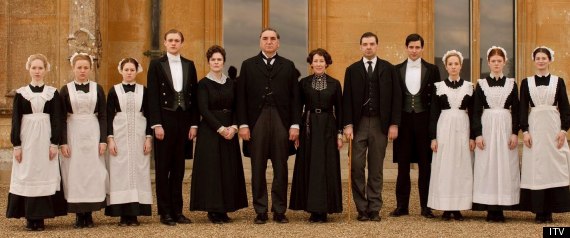
IMG_4572Although I am planning to use Butterick B6229 for the dress, I did not use a pattern for the apron. The Butterick pattern relies on ruffles and pintucks to add visual interest to the apron, but I wanted to use antique lace accents. You can see in the picture below that there is quite a lot of variation between the aprons on the show. There are different hem lengths, and different ways to arrange the lace on the upper part.

r-DOWNTON-large570I sewed 3 strips of insertion lace into a V shape, then placed another strip of lace across the top, to make the center of the apron top. I then used 2 long pieces of wide lace to finish off the sides.

IMG_4574The bottom of the apron is about 44 inches wide. (I used the width of the fabric I had, which happened to be the same width as the lace left over from the top part of the apron).  I added lace on the hem because it’s pretty, and to save me a few rows of pintucks! Pintucks aren’t difficult to do; I just avoid them because I’m a little OCD and it bugs me when they’re not perfectly straight and even.

IMG_4577Most of the aprons on Downton Abbey have plain, pintucked hems, but some have lace, like Ethel’s on the far right.

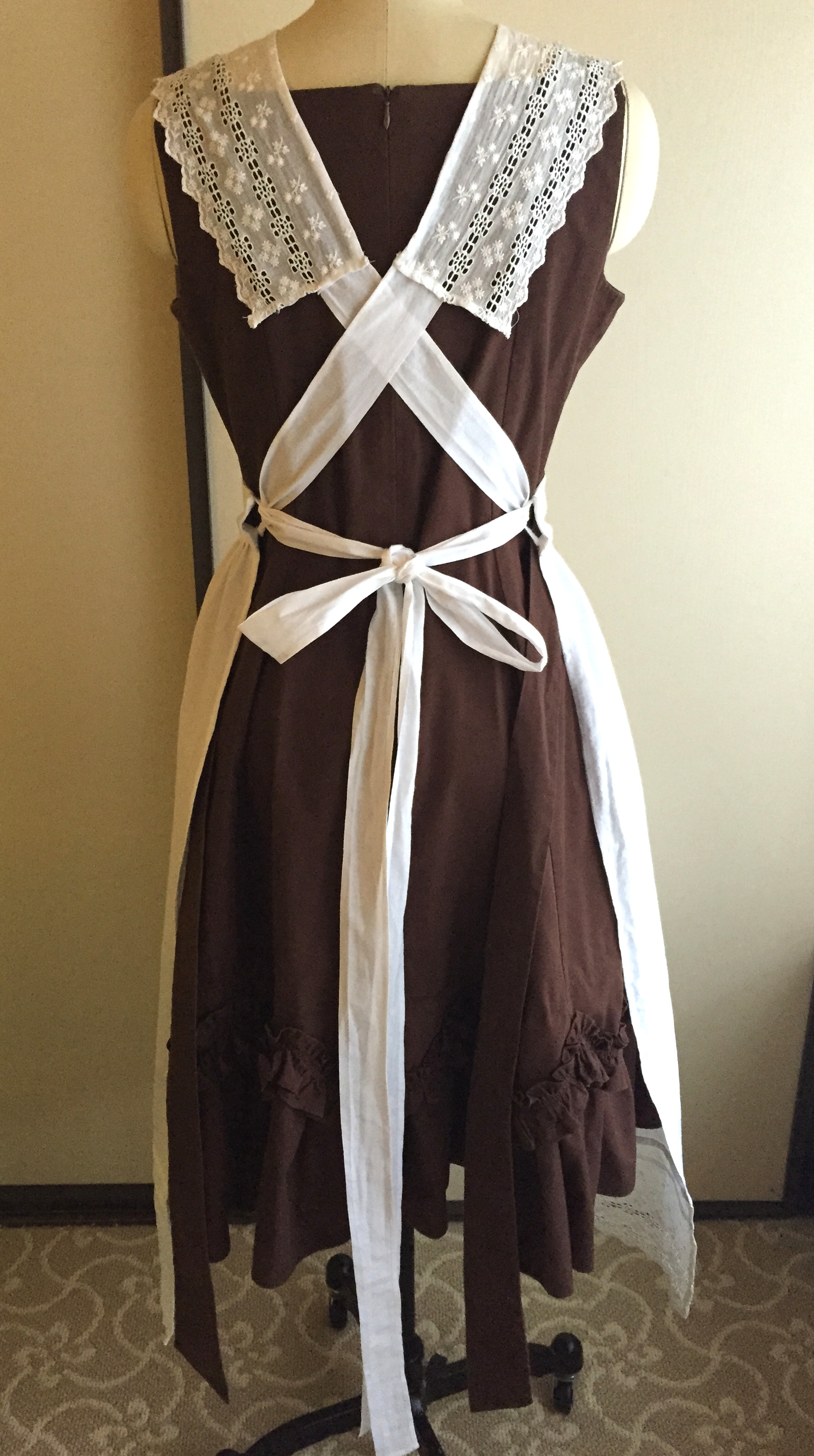
tumblr_m1hgaycfA01r9qe4yInstead of having two sets of ties (at the waist and upper back) I used one very long pair of ties. (They are about 2 inches wide, and 60 inches long, and probably too long). They come out of the shoulder lace, criss-cross on the back, go into loops sewn into the waistband, then tie at the waist. This way I only have one set of ties to worry about, and the straps across the back will hopefully stay more neatly arranged.

I wasn’t fond of the way the back looked in its first iteration . . .IMG_4579. . . so I pleated the lace where the straps meet, and I think it looks much better.

FullSizeRender

See Part 1 here.